









Before-and-after ads are allowed on Meta for cosmetic procedures, but only when the ad is aimed at adults 18 and older, avoids making viewers feel bad about their bodies, and shows results you can honestly document. Meta’s policy is only half the picture. The FTC’s rules on substantiation apply to the same image, and a landing page that overpromises can sink an ad that was otherwise clean. This guide walks through both sets of rules, shows which parts of your creative trigger rejections, and gives you a review routine to run before anything goes live.
It is written for clinic owners and practice managers: med spas, plastic surgeons, pain management and imaging clinics, mental health practices, and the home-service and real estate businesses that also lean on transformation photos.
TL;DR
- Meta’s health and wellness standard, last updated December 27, 2024, allows before-and-after imagery for general cosmetic products, procedures and surgeries when the audience is 18 and older.
- Ads get rejected for what they imply: negative comments about someone’s body, close-ups of pinched fat, a promised result in a fixed timeframe, or text that tells the viewer they have a condition.
- The FTC separately expects you to hold adequate substantiation for any objective claim an image conveys, before the ad runs.
- Your landing page, ad copy and targeting are reviewed alongside the image, so the whole path has to be consistent.
- If before-and-after images are not a fit for your category, there are strong creative formats that carry no results claim at all.
Table of Contents
- What Meta’s before-and-after rule actually says
- What triggers a rejection
- The FTC rule that applies to every image
- Which of your services this affects most
- A pre-launch review for before-and-after ads
- What to run when before-and-after images are not an option
- Why the landing page decides whether the ad pays
- Our perspective
- How AdJet can help
- FAQ
- Sources
What Meta’s before-and-after rule actually says
Meta does not ban before-and-after images across the board. The rule sits inside its Health and Wellness advertising standard, and the answer depends on what you advertise.
For cosmetic products, procedures and surgeries, the standard allows ads that depict a before-and-after transformation, provided the ad is targeted to people 18 or older. The procedures Meta lists as allowed include fillers, injectables, chemical peels, laser treatments, rhinoplasty and hair restoration. That covers most of what med spas and plastic surgery practices actually sell.
The same page also sets the limits. It prohibits:
- statements implying the viewer is inferior in appearance, or that they need to change how they look;
- close-up images of pinched fat;
- results claims based only on what a person wears;
- skin whitening or bleaching claims that promise a permanent color change;
- claims to cure, heal or eliminate a list of incurable or terminal conditions, with an allowance for claims about treating or managing symptoms;
- clickbait promises of a specific outcome in a set timeframe.
The weight-loss rule works a little differently. Ads for dietary, health and weight loss or gain products are subject to the same 18+ targeting requirement. Prescription weight-loss products additionally have to comply with Meta’s Drugs and Pharmaceuticals policy, which includes geo-targeting and written permission.
Why does Meta draw these lines? The rules aim at ads that exploit insecurity or promise outcomes no one can guarantee. If you keep that purpose in mind, most borderline decisions become easy to make.
A note on timing
Policies change. The version cited here is the December 27, 2024 standard, which is the one Meta’s Transparency Center lists for this topic. Meta revises its standards without a fixed schedule, so check the live page before you build a large campaign and again when an ad that used to run gets rejected.
What triggers a rejection
Ad reviewers look at the image, the headline, the primary text, the targeting and the destination page. A rejection usually comes from one of these, even when the photo itself is permitted.
| Element | Usually fine | Likely to be flagged |
|---|---|---|
| Image | Two consistent, well-lit photos of a procedure result, shown to adults | Close-ups of pinched fat, exaggerated edits, images that make the body look like a problem |
| Headline | Names the service and the benefit | Tells the viewer what is wrong with them |
| Primary text | Describes the treatment and what a consultation covers | Promises a result in a fixed number of days |
| Targeting | 18+ audience | Any audience that includes minors |
| Landing page | Matches the ad, explains the procedure and the consultation | Makes stronger claims than the ad, or implies a cure |
Personal attributes: the copy problem
The most common rejection we see described by clinics has nothing to do with the photo. It is the sentence under it. Meta’s personal attributes standard prohibits ads that assert or imply something about the viewer, including health or medical conditions, disability, age and vulnerable financial status. Ads should focus on the benefits of the product or service.
Compare two lines for the same service:
- Flagged: “Are you tired of your embarrassing acne scars?”
- Cleaner: “Laser treatments for acne scars. Book a consultation to see if you’re a candidate.”
The first tells the viewer they have a condition and implies a feeling about it. The second describes the service. Meta does allow “you” and “your” when no personal attribute is attached, passing references to age groups, and health public service announcements that do not claim someone has a condition. So “your skin” is fine, while “your scars” is a judgment call you should avoid.
This matters even more for mental health, pain and imaging practices, where the condition is the service. Write about the service and what a visit involves. Do not write as if you already know the viewer’s diagnosis.
The FTC rule that applies to every image
Meta’s review is about whether your ad can run on its platform. The FTC’s question is different: is the claim true and can you prove it?
The FTC’s Health Products Compliance Guidance says advertisers need adequate substantiation before an objective claim is disseminated. That applies to claims stated outright and claims conveyed by implication, including through images. For health-benefit claims, the guidance generally calls for competent and reliable scientific evidence: tests, analyses, research or studies conducted and evaluated by experts and sufficient in quality and quantity under accepted standards in the relevant field.
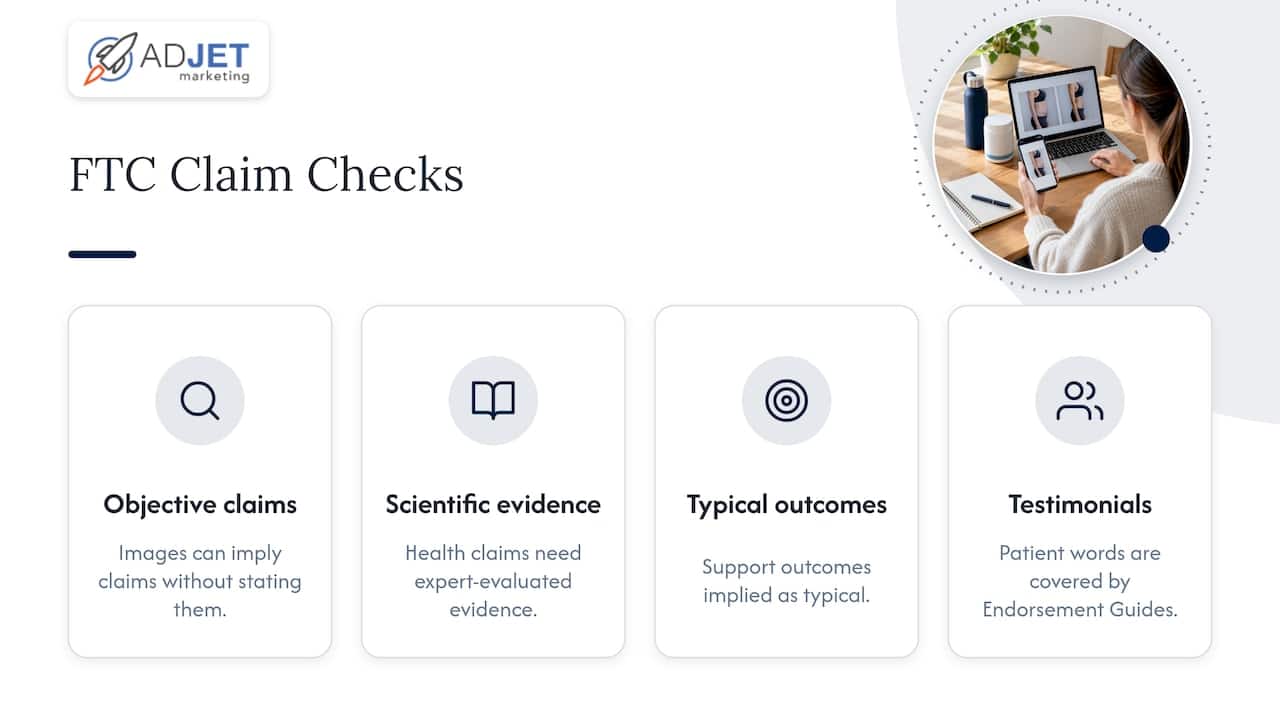
The guidance includes an example that shows how a photo pair becomes a claim. A fictional ointment ad shows an elderly woman using a walker in the before picture and dancing in the after picture, without naming the product. The FTC says that likely conveys that the ointment can dramatically improve arthritis symptoms, so the advertiser needs evidence for it.
For your practice, the lesson is practical: an after photo is a statement. If it implies that a typical patient gets that outcome, you need support for “typical.” If it shows one patient’s best result, the surrounding copy should not suggest otherwise. The FTC’s Endorsement Guides also address how testimonials and endorsements are treated under Section 5 of the FTC Act, which is relevant whenever a photo comes with a patient’s words.
This is general information, not legal advice. For a specific claim about outcomes, safety or a medical condition, have your healthcare or advertising attorney review it.
Which of your services this affects most
Different practices land in different places.
- Med spas and aesthetic practices: Your core services are on Meta’s allowed list for cosmetic procedures. Your work is mostly in image quality, consent and wording. Our med spa before-and-after rules guide goes deeper on the practitioner side, and the Botox advertising policy page covers what injectables clinics can say.
- Plastic surgeons: Surgery results are among the most sensitive photos. Keep angles, lighting and poses consistent, avoid close-ups that read as body shaming, and avoid timeframe promises. Our plastic surgery Google Ads guide covers how the same discipline carries over to search ads.
- Pain management and imaging clinics: Visual transformation is rarely the right creative. Lean on explanation, provider credentials and the consultation process. Our pain clinic advertising policy page covers the rules.
- Mental health therapists, psychiatry and family counselors: Before-and-after imagery does not fit your work, and personal attribute rules apply strongly. Write about the service, not about what the viewer is going through.
- Home services and real estate agents: Renovation and staging transformations are a natural fit for this format. One practical tip from advertiser communities is to keep people out of the frame so an automated system does not read the ad as a body-transformation ad. Treat that as a working habit, not a rule you can rely on.
- Private schools and cannabis retailers: These categories carry their own advertising restrictions. A before-and-after format is rarely the right tool, so review each platform’s rules for your category before creating one.
Google Ads has its own healthcare rules that are separate from Meta’s. Our healthcare Google Ads restrictions checklist covers those, so you do not apply the wrong set of rules to the wrong platform.
A pre-launch review for before-and-after ads
Run this routine for every new creative. It takes ten minutes once it is a habit, and it prevents the situation we hear about often: a clinic that spent weeks on creative only to have it rejected on the first day.
- Confirm the service is on the allowed list. Check that what you are advertising falls within a category Meta allows for before-and-after imagery, such as fillers, injectables, peels, lasers, rhinoplasty or hair restoration. If your service is a prescription weight-loss product, the Drugs and Pharmaceuticals policy applies as well. Where it goes wrong: assuming one approved ad means every similar service is approved.
- Set the audience to 18+. Do it at the ad set level and confirm it before publishing. Where it goes wrong: reusing a broad audience from another campaign.
- Audit the image. Is it a fair, consistent comparison with the same angle, lighting and distance? Is any part of it a pinched-fat close-up, or does it make the body look like a defect? Remove anything that does.
- Audit the copy for personal attributes. Search every headline and line of text for phrases that assert something about the viewer, such as a condition, an age, a financial situation or a feeling about their body. Rewrite them around the service.
- Remove timeframe promises. “Results in 7 days” is the kind of clickbait outcome promise Meta bars. Describe what the treatment is and let the consultation set expectations.
- Match the claim to your evidence. For every outcome the image conveys, ask what you could show if the FTC asked. If the answer is one patient’s result, say so plainly and do not imply it is typical.
- Confirm patient consent and privacy handling. Photos of real patients belong in a consent process your privacy counsel has signed off on. For clinics, we build tracking and retargeting around HIPAA-compliant processes so that campaign data and patient information stay protected.
- Check the landing page. The page should match the ad, explain the procedure and offer a consultation. A page that says more than the ad did can create a problem for both.
- Keep a record. Save the approved version of each ad, its date and the policy version you checked it against. When a policy changes, you will know exactly which ads to revisit.
What to run when before-and-after images are not an option
Sometimes the image does not fit the platform, the category or your own comfort level. These formats carry no results claim and still drive consultation requests:
- Provider introduction video. Thirty to sixty seconds from the practitioner on who they are, what they treat and what a first visit looks like.
- Procedure walkthrough. A short explainer showing the room, the steps and the recovery process.
- Educational carousel. Common questions, such as how a treatment works and who is a candidate, one idea per card.
- Consultation offer. A clear invitation to book an evaluation, with the process spelled out.
- Facility and team photography. Real images of your space and staff build familiarity before the first visit.
- Patient stories in the patient’s words, with consent. Keep these free of outcome promises and make sure they are not presented as typical.
For home services and real estate, the same logic applies. Show the finished project or the staged room, and let the work speak for itself.
Why the landing page decides whether the ad pays
Passing review is the floor. What happens after the click determines whether the ad returns money. Many clinics come to us after spending on ads that were approved but sent traffic to a generic homepage with no clear next step. The ad did its job and the page lost the visitor.
A landing page built for a single treatment should repeat the promise of the ad, explain the procedure in plain language, show your credentials and make booking a consultation easy. Our guides on high-converting landing page design and medical landing page elements cover the structure we use.
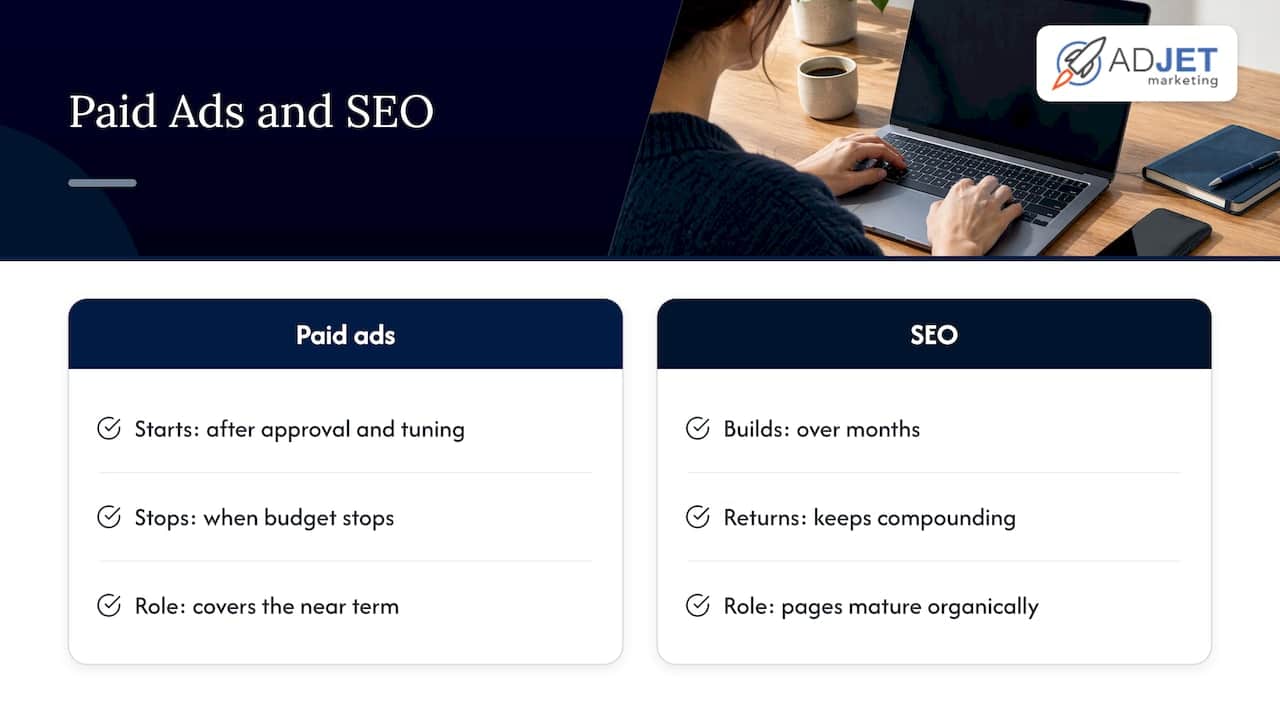
If you run both paid and organic efforts, this is where the comparison between ads and SEO becomes honest. Paid ads can start generating inquiries once campaigns are approved and tuned, but they stop when the budget stops. SEO takes months to build and keeps compounding. Most clinics do best with both, with ads covering the near term while organic pages mature. Timelines and results vary by market and competition, so we set expectations in writing before we begin.
Our perspective
We approach before-and-after policy as a design constraint, not an obstacle. The clinics that struggle with it are usually the ones that built their ads first and read the policy second.
What we see in practice is a pattern: a practice wants to show results, the ad is rejected, and the team rewrites the copy a few times without understanding which element triggered it. The fix is almost always one of four things: the audience, the image, a sentence that addresses the viewer’s body or condition, or a promise tied to a timeframe. Once you know where to look, review becomes quick.
We also think the image is only one part of the job. A compliant ad that leads to a weak page wastes the budget, and a strong page behind a rejected ad never gets seen. That is why our work covers the ad, the landing page and the conversion path together, with HIPAA-compliant processes and reporting that shows which creative produced booked appointments.
If you want a second set of eyes on a creative before it goes live, that is a normal part of how we work with clinics.
Felix
How AdJet can help
We are a Google Partner agency that builds and manages ads, WordPress websites and landing pages for clinics and aesthetic practices. If you want landing pages that match your approved ads, our landing page design plans start with a Starter Plan at $299 per month, and the Premium Plan is $1,500 per month. If you want a team to run the campaigns, see our Google Ads management and conversion rate optimization services.
FAQ
Can I use before-and-after photos in Meta ads?
Yes, for general cosmetic products, procedures and surgeries, as long as the ad is shown to people 18 and older and follows the rest of Meta’s health and wellness standard. Review the current policy page before each new campaign, since Meta can update it.
Why was my before-and-after ad rejected?
The most common causes are copy that implies a condition or a flaw about the viewer, an image that reads as body shaming, a promised result in a set timeframe, or an audience that includes minors. Check the headline, text, targeting and landing page, not just the photo.
Do I need proof for the results I show?
The FTC expects adequate substantiation before you make an objective claim, including claims an image conveys. Health-benefit claims generally call for competent and reliable scientific evidence. Ask your attorney to review any outcome claim before it runs.
Can mental health practices use before-and-after ads?
It is not a natural fit, and Meta’s personal attributes rules restrict ads that assert or imply a health condition about the viewer. Focus on the service, the clinician and how to book, and avoid copy that tells viewers what they are going through.
Do the same rules apply on Google Ads?
No. Google runs its own healthcare advertising policies, separate from Meta’s. Review them on their own terms, starting with our healthcare Google Ads checklist.
Sources
- Health and Wellness, Meta Transparency Center
- Privacy Violations and Personal Attributes, Meta Transparency Center
- Health Products Compliance Guidance, Federal Trade Commission
- Guides Concerning the Use of Endorsements and Testimonials in Advertising, Federal Trade Commission