









Answer engine optimization (AEO) is the work of structuring your practice’s website and online profiles so that search engines and AI assistants can pull a clear, accurate answer from them and, ideally, name your practice as the source. For a medical practice, it is mostly good SEO with sharper writing, cleaner entity data and a review process that protects patients. It does not replace the fundamentals, and it does not come with guarantees.
This guide explains what AEO is in plain terms, how it relates to SEO and generative engine optimization (GEO), the steps worth taking first, how to stay compliant, and how to measure something that is genuinely hard to measure.
TL;DR
- AEO means writing and structuring content so AI assistants and answer features can extract a direct, correct answer. For most practices it is an extension of SEO, not a separate channel.
- Start with the basics: answer each patient question in the first two sentences, keep your practice name, address and category identical everywhere, and add Organization and LocalBusiness schema.
- In healthcare, accuracy is the whole game. Every page needs clinical review, and marketing claims need to be defensible.
- Measure branded searches, qualified inquiries, and how patients say they found you. Expect attribution to be imperfect and results to take months.
- Do not buy a promise of AI citations. No one controls what an AI assistant says.
Table of Contents
- What AEO means for a medical practice
- How AEO relates to SEO and GEO
- The practical steps, in order
- Keeping AEO content accurate and compliant
- What AEO looks like for different practice types
- Measuring AEO without fooling yourself
- Timelines and budget: what to expect
- How to evaluate an AEO offer
- Where AdJet Marketing can help
- FAQ
- Sources
What AEO means for a medical practice
When a patient asks a question such as “does Botox hurt” or “what does a lumbar epidural injection involve”, they may never see ten blue links. They may see a summary, hear a spoken answer, or get a response from a chat assistant. AEO is how you make your practice’s content the kind of material those systems can read, trust and quote.
For a clinic, this changes three things in practice:
- Pages are written as answers. Each page or section opens with a direct response to one real patient question, then adds detail.
- Your identity is unambiguous. Machines need to know who you are, where you are, what you treat and who the clinicians are.
- Review is stricter. An answer lifted out of context has to be correct on its own.
The patients who benefit are the ones already searching for a treatment or provider. Many of the clinics that come to us are not short on traffic. They are short on qualified inquiries, and AEO work tends to overlap with fixing that: clearer pages, clearer next steps.
How AEO relates to SEO and GEO
The terms get used loosely. One marketing platform describes AEO and GEO as approaches to visibility in AI-generated and answer-driven experiences, noting that some people use AEO as an umbrella term while others reserve GEO for generative AI outputs. Traditional SEO, by contrast, focuses on ranking in standard search results.
For practical decisions, the more important point comes from Google itself. Its guidance says that optimizing for generative AI features is an extension of SEO, because those features still rest on Google’s core ranking and quality systems.
Here is how we explain the difference to clinic owners:
| SEO | AEO / GEO | |
|---|---|---|
| Goal | Rank pages in search results | Be quoted or cited in answers and summaries |
| Unit of work | A page targeting a keyword | A clear answer targeting a question |
| Key inputs | Content, links, technical health, local signals | Same inputs, plus answer formatting, entity consistency and structured data |
| What you track | Rankings, traffic, calls, bookings | Citations where visible, branded demand, qualified inquiries |
| Control | Moderate | Low |
If your SEO is weak, AEO will not rescue it. If your SEO is solid, AEO is mostly a matter of tightening how you present information. Our guide to medical SEO for clinics covers that foundation.
The practical steps, in order
These are the steps we would put first for a typical independent practice. They are ordered by effort against likely benefit.
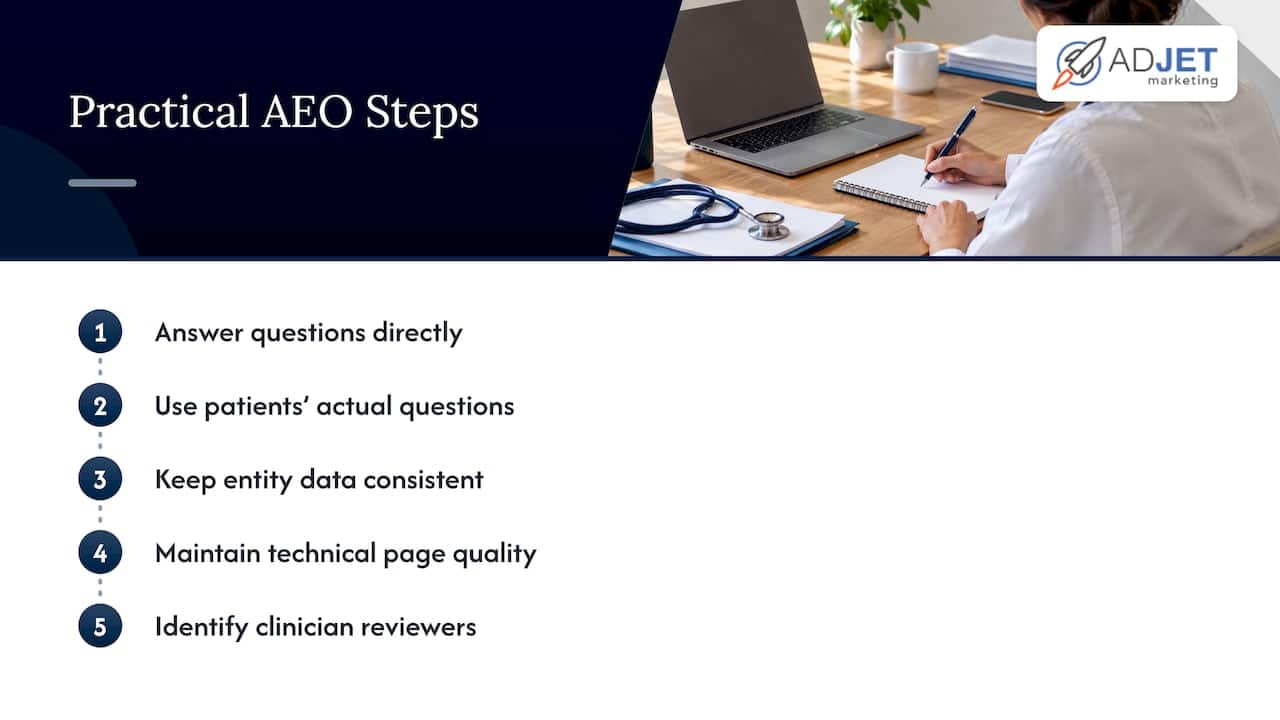
1. Answer the question in the first two sentences
A professional marketing association’s AEO field guide recommends answering the question in the first two sentences and keeping the answering paragraph between 40 and 80 words. That is a sensible format for patients too. People scanning a treatment page want the answer before the story.
A workable pattern for a treatment or condition page:
- A heading phrased as the topic or question patients use.
- A 40 to 80 word answer, written in plain language, reviewed by a clinician.
- Detail underneath: who it is for, what the visit involves, recovery, risks, cost range if you publish one.
- A clear next step, such as booking a consultation.
An example for a pain clinic: “A lumbar epidural steroid injection is a procedure in which a physician delivers medication near irritated spinal nerves in the lower back. It is typically considered after conservative care. Whether it is appropriate depends on your diagnosis and history, which a physician evaluates at a consultation.” That is quotable, careful and does not promise relief.
2. Write about the questions patients actually ask
Pull questions from your front desk, consultation notes, call recordings and online reviews. Group them by service. Then answer each one on the relevant page, in the words patients use, not the words on your equipment brochure.
Prioritize the questions that sit close to a booking decision: cost, safety, recovery, who performs the procedure, whether insurance applies, what to expect at the first visit. These are also the questions that bring in qualified inquiries rather than casual readers.
3. Make your entity data consistent
The same field guide advises using Organization and LocalBusiness schema on entity pages and keeping an identical name, address, category and description everywhere your practice appears. In our audits, inconsistent listings are one of the most common problems: an old suite number, a former practice name, a different phone number on a directory.
A short checklist:
- Same practice name, address and phone number (NAP) on your site, Google Business Profile and major directories.
- One short description of the practice, reused with minimal changes.
- Accurate primary and secondary categories on your Google Business Profile.
- Individual clinician pages with credentials, specialties and licensure.
- Schema markup that matches what is visible on the page.
If local visibility is your weak spot, start with our plain-language guide to local SEO for clinics.
4. Keep the page technically clean
Answer systems read the same pages Google crawls. Fast pages, clear headings, descriptive page titles and a logical structure help both people and machines. Our walkthrough of on-page SEO in healthcare lists the elements we check, and a slow site can undermine everything else, so see also how website speed affects booking.
A caution on schema: no markup type guarantees that an AI feature will cite you. Google’s guidance treats AI optimization as ordinary SEO practice, not a special markup trick. Use structured data because it clarifies your content, not because someone sold it as a shortcut.
5. Show who is behind the content
Health information is judged more strictly than most topics. Name the clinician who reviewed each page, list their credentials, and show when the page was last reviewed. Link to your clinicians’ profiles. This helps patients first and machines second.
Keeping AEO content accurate and compliant
This is where healthcare differs from every other industry. One healthcare marketing analysis frames AEO in medicine as a compliance and patient safety discipline that needs layered review, because content has to be extractable and also legally and clinically accurate.
The reasoning is simple. A sentence that is fine inside a full page can mislead when quoted alone. “Results are immediate” without the surrounding context about candidacy and risks becomes a problem when a machine lifts it out. Clinical accuracy and patient safety risks, such as those involved when anesthesia is part of a procedure, are exactly why each answer needs a qualified reviewer before it goes live.
A review process we recommend for any practice:
- Draft the answer in plain language from a real patient question.
- Clinical review by the physician or licensed clinician who provides the service. They check facts, scope and wording.
- Compliance review for advertising claims, testimonials, before-and-after images and any statements about outcomes. Your counsel or compliance officer should make final calls on what is permissible in your state and specialty.
- Privacy check so no patient information appears in content, forms or tracking set-ups in ways your HIPAA obligations do not allow.
- Publish and date the page, with reviewer name and review date.
- Re-review on a schedule, and any time clinical guidance or your services change.
Writing rules that reduce risk
- Describe what a procedure is and who may be a candidate, not what it will do for the reader.
- Avoid guarantees, absolute words and unsupported superlatives.
- Do not publish medical advice that substitutes for a consultation. Tell patients which professional to see for their situation.
- Cite clinical statements to authoritative sources, such as medical societies and government health agencies, where a claim is factual.
- Keep patient stories and reviews within the rules that apply to your practice, and have them checked before publication.
There is also a patient safety reason to care. If you do not publish clear, accurate answers, other sources will fill the gap, and they may not be as careful as you are.
What AEO looks like for different practice types
The approach is the same, but the questions differ.
- Med spas and aesthetic practices: pricing context, downtime, candidacy, who administers treatments, and safety. Keep claims measured and consistent with what your providers can substantiate.
- Plastic surgeons: recovery timelines, surgeon credentials, facility details, and realistic expectations. Clinician-reviewed answers matter most here.
- Pain management clinics: condition explainers, procedure descriptions, and what a first consultation involves.
- Mental health and psychiatry practices: what therapy or medication management looks like, how to get started, insurance and telehealth. Take extra care with privacy and with anything resembling crisis guidance.
- Imaging centers: what each scan involves, preparation, duration, and referral requirements.
For aesthetic practices in particular, our med spa marketing page outlines how we approach websites and landing pages for that audience.
Measuring AEO without fooling yourself
Measurement is the weak point of AEO, and it is better to say so up front. You often cannot see when an assistant mentions your practice, and the patient who later calls may never have clicked anything. Here is what we track instead.
Signals you can measure
- Branded search volume and branded clicks in Google Search Console, as a rough indicator of growing awareness.
- Organic traffic to answer-style pages, and how those visitors behave: scroll depth, clicks to call or book.
- Qualified inquiries, not raw form fills. Define “qualified” with your front desk: right service, right location, right intent.
- “How did you hear about us?” on forms and intake calls, with an option such as “AI assistant or chatbot” alongside search, referral and social.
- Manual spot checks. Periodically ask the common assistants the questions patients ask and record whether your practice appears, how it is described, and whether the answer is accurate. Treat this as a sample, not a ranking, since responses vary.
- Google Business Profile actions: calls, direction requests and website clicks.
Why attribution is hard
Patients move between devices and channels. An assistant may inform a decision, and the patient then searches your name directly, which looks like a branded or direct visit. Answers also differ from one session to the next. Any report that claims to show exact AI-driven revenue deserves skepticism. Our reporting focuses on trends in qualified inquiries and bookings, and we say plainly where the data is inferred.
Timelines and budget: what to expect
AEO builds on content and authority that take time to establish. In our experience, a practice that already has a sound website and accurate listings can see early signs, such as better-structured pages and more consistent snippets, within a few months. Changes in qualified inquiries usually take longer and depend on competition, your market and how much you publish. We cannot promise a specific outcome, and no honest agency can.
On budget, AEO is rarely a standalone line item for a smaller practice. It is typically folded into SEO and content work. If you have limited funds, spend in this order:
- Fix site fundamentals and listing consistency.
- Rewrite your top service pages as clinician-reviewed answers.
- Add supporting FAQ content and schema.
- Build out new content around lower-priority questions.
If you need leads sooner than organic work can deliver, paid search can bridge the gap. We compare the two in our overview of SEO strategies for patient leads and cover paid in benefits of Google Ads for medical clinics. Paid ads buy visibility now and stop when the budget stops. SEO and AEO compound more slowly and last longer. Most practices need a mix.
How to evaluate an AEO offer
If an agency pitches you AEO, ask what the deliverables are. Reasonable ones include page rewrites, schema, entity cleanup, a review workflow and a measurement plan. Be wary of promises to guarantee citations, claims of a secret formula, or any pitch that skips clinical and compliance review. A good partner will talk about process and evidence, and will be clear about what is outside their control.
Perspective from our team
Many clinics come to us after a stretch of poor lead quality: plenty of clicks, few patients who fit the practice. When AI answers started appearing in search, the first reaction was to look for a new trick. We see it differently. The practices that do well are the ones whose websites already answer patients clearly, whose information is consistent everywhere, and whose content is reviewed by the people accountable for the care.
We build AEO into SEO, web design and conversion work rather than selling it as a separate miracle. A page that answers a question well, loads quickly and gives the patient an obvious next step serves search engines, assistants and people at once. We also keep HIPAA-conscious processes in place because compliant marketing and growth are not in conflict. They depend on each other.
Our advice is to be patient with the timeline, strict about accuracy and honest in your measurement. That combination is less exciting than a promise of overnight citations, and it is more likely to hold up.
Felix
Where AdJet Marketing can help
We are a Google Partner agency working with medical clinics, aesthetic practices and other local healthcare providers. If you want your service pages restructured for clear answers, your listings and schema cleaned up, and your site built to turn visitors into booked appointments, start with our search engine optimization services. To see how we think about AI-driven visibility specifically, read about earning AI citations.
FAQ
Is AEO different from SEO for a medical practice?
In practice, they overlap heavily. Google’s own guidance treats optimizing for AI features as an extension of SEO. AEO adds emphasis on direct answers, entity consistency and structured data, plus a stricter clinical review process.
Can I guarantee my practice will be cited by AI assistants?
No. You cannot control what an assistant says or which sources it uses. You can make your content clear, accurate and consistent so it is easier to use, and you can check periodically how your practice is described.
How long does AEO take to work?
It depends on your starting point, competition and how much you publish. Technical and content improvements can be done in weeks, but changes in qualified inquiries often take several months. Attribution is imperfect, so track trends rather than single numbers.
What should a healthcare AEO page include?
A direct 40 to 80 word answer near the top, supporting detail, the reviewing clinician’s name and credentials, a review date, matching schema, and a clear next step. Every clinical statement should be checked by a qualified clinician before publishing.
Do I need to worry about HIPAA with AEO?
AEO content itself is public information, but the forms, tracking tools and analytics around it can touch patient data. Have your compliance officer or counsel review your set-up, and keep protected health information out of content and tracking.
Sources
- Google Search Central: Guide to optimizing for generative AI features
- HubSpot: AEO vs. GEO explained
- AMA Orlando: AEO Field Guide
- Siteimprove: Answer Engine Optimization for Healthcare
- Forever Smiles Jax: Role of an Anesthesiologist in Dental Surgery