









An offline conversion in healthcare is any patient outcome that happens after the click and outside your website: a phone call that books, a consultation that happens, a treatment that gets paid for. To track one, you match a lead captured online to the outcome recorded in your scheduling or billing system, then send the ad platform only the minimum it needs to learn which clicks produced patients. Done well, this stops your campaigns from optimizing for form fills that never show up, and it can be done without sending protected health information (PHI) to an ad platform.
Many clinics come to us after poor lead quality: the dashboard shows plenty of conversions, while the front desk reports spam, price shoppers and no-shows. The fix is usually not more traffic. It is better feedback to the ad platform about which leads became patients.
TL;DR
- Offline conversions connect an ad click or lead to a later event, such as a booked consult, a completed visit or revenue, so Google Ads can optimize for patients instead of form submissions.
- The technical minimum is a captured click ID or hashed contact details, a conversion timestamp, and ideally a value and a unique order ID.
- In healthcare, send the outcome event, not the diagnosis. Share only what the measurement purpose requires, and have your privacy officer or healthcare counsel confirm your setup.
- Judge results over a full sales cycle, expect gaps, and compare your own booked and paid appointments to what the platform reports.
Table of Contents
- What counts as an offline conversion in a clinic
- Why platform conversions mislead clinics
- How the connection works, step by step
- Keeping PHI out of the measurement
- Reading the numbers without fooling yourself
- Paid ads or SEO: does this only apply to Google Ads?
- Our perspective
- How AdJet can help
- FAQ
- Sources
What counts as an offline conversion in a clinic
An online conversion happens in the browser: a form submit, a click-to-call tap, an online booking. An offline conversion happens later, in your phone system, practice management software or front desk. One clinic marketing guide describes the category as calls, in-clinic visits and referrals influenced by marketing, which matches what we see in practice.
The outcomes worth tracking depend on your specialty:
- Med spas and aesthetic practices: consultation held, treatment package purchased, repeat visit.
- Plastic surgeons: consultation attended, surgery date booked, deposit paid.
- Mental health therapists, counselors and psychiatry clinics: intake call completed, first session attended.
- Pain management and imaging clinics: referral received, appointment completed, scan performed.
- Private schools: tour completed, application submitted, enrollment.
- Real estate agents: appointment held, listing signed, closing.
Notice the pattern. The valuable event almost always happens after the first contact, and the platform never sees it unless you send it back.
Why platform conversions mislead clinics
If Google Ads counts every form submission as equal, its bidding system learns to find more people who fill out forms. That is not the same group as people who show up and pay. A campaign can look efficient at a low cost per lead while producing few patients, and a campaign that looks expensive can be your best source of booked treatments.
By importing the downstream outcome, you let the bidding system learn from it. Google describes offline conversion imports as a way to track what happens after a click, and enhanced conversions for leads as an upgraded version that uses user-provided data such as email addresses to improve accuracy and bidding performance.
How the connection works, step by step
The routine has five steps. Each one has a common failure point.
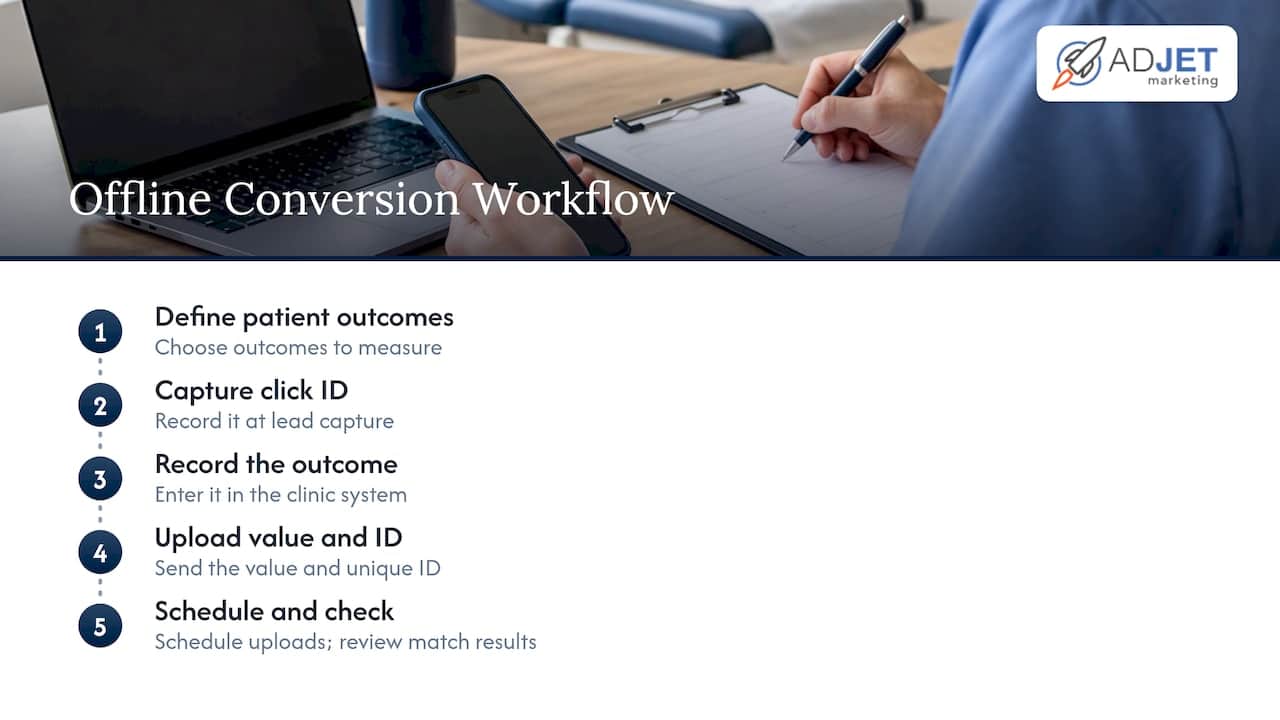
Step 1: Define the outcomes you will import
Pick one or two events that mark a real patient, not ten. A good first pair is “consultation attended” and “treatment paid.” Fewer, cleaner events give the bidding system a clearer signal.
Where it goes wrong: clinics import “appointment requested,” which is just another form fill in disguise. Choose events your staff confirm, not events the website generates.
Step 2: Capture an identifier at the moment of the lead
Google’s developer documentation says an upload needs an enabled upload-click conversion action and a conversion date and time with a time zone. It also asks for a click ID (GCLID, GBRAID or WBRAID) when available. Where you rely on enhanced conversions for leads, Google requires normalized, SHA-256 hashed email or phone identifiers. Hashing means converting the value into a fixed code before it is sent, so the raw email or phone number is not transmitted in readable form.
Practically, that means your landing page form needs to store the click ID in a hidden field and pass it into your CRM or scheduling system along with the contact details.
Where it goes wrong: the click ID is lost between the ad and the form, because of redirects, a third-party booking widget or a form that does not carry the field. Phone leads are the other leak. If calls are your main channel, our guide to fixing phone call conversion tracking for clinics covers how to capture them reliably.
Step 3: Record the outcome in your system of record
Your front desk or practice management software is where the truth lives. Someone has to mark the lead as attended, treated or paid, and the status must be tied to the original lead record. Without that discipline, nothing downstream works.
Where it goes wrong: statuses are updated inconsistently, so the upload undercounts your best campaigns. A simple rule helps: the status is updated the same day the visit happens, by the same role every time.
Step 4: Build the upload with value and a unique ID
Google recommends sending a conversion value with a three-character ISO 4217 currency code (USD for US clinics) and a unique order ID. The order ID prevents duplicate imports and lets you adjust a conversion later, for example after a refund.
Value can be actual revenue, or a modeled average. For a first attended consult, many practices assign a fixed value based on their historical consult-to-treatment rate and average treatment revenue, then use actual revenue for paid events.
Where it goes wrong: inflated or inconsistent values. If one campaign’s leads are assigned values by a different method than another’s, the platform will chase the wrong one.
Step 5: Upload on a schedule and check the match
Upload at least weekly, and daily for high-volume accounts. One platform change matters here: Google’s help page states that starting June 15, 2026, offline conversion import and enhanced conversions for leads uploads move to the Data Manager API and are blocked in the Google Ads API. If a developer or vendor built your pipeline earlier, confirm it uses the current method.
Where it goes wrong: uploads fail partially and nobody reads the error report. Google’s documentation treats partial-failure reporting as required, so review it after every batch.
Keeping PHI out of the measurement
This is the part healthcare marketers worry about most, and rightly. The rule of thumb is simple: the ad platform needs to learn that a click turned into a patient outcome. It does not need to learn why the person sought care.
Here is what the federal guidance says:
- The U.S. Department of Health and Human Services (HHS) states that disclosures of PHI to tracking vendors must be permitted under the HIPAA Privacy Rule. A vendor that receives PHI to perform a covered function is a business associate and needs a business associate agreement (BAA). A privacy notice or cookie banner does not by itself authorize a disclosure.
- HHS’s Office for Civil Rights recommends addressing tracking technologies in your risk analysis and risk management, with safeguards such as encryption, authentication, access controls and audit controls when electronic PHI goes to or sits with a vendor.
- In June 2024, a federal court in Texas vacated one part of that guidance, the portion about information collected on public, unauthenticated web pages. It did not vacate the rest. The practical reading is that your obligations around PHI in authenticated areas and in data you hold in your own systems did not go away.
- Two provisions in the Privacy Rule shape the design, as summarized in the Washington Health Care Authority’s privacy toolkit. Under 45 CFR 164.502(b), where the minimum-necessary standard applies, use or disclosure should be limited to what the purpose requires. Under 45 CFR 164.508(a)(3), disclosing PHI for marketing generally requires patient authorization, subject to exceptions.
What this means for how you build the feed
Use data minimization as the design principle. Define the measurement purpose first, then send only what that purpose needs.
| Send | Avoid sending |
|---|---|
| Event type such as “consult attended” | Diagnosis, condition or treatment details |
| Conversion time and time zone | Clinical notes or free-text fields |
| Value and currency | Insurance or medical record numbers |
| Click ID or hashed identifier | Names alongside a service that reveals a condition |
| Unique order ID | Provider notes or appointment reasons |
For sensitive specialties such as mental health, pain management and psychiatry, a generic event name matters. Name the conversion “qualified appointment,” not something that reveals the service line. Whether a given identifier plus an event counts as PHI in your situation is a question for your HIPAA privacy officer or healthcare attorney. Ask them to review the final data map before the first upload.
If you run remarketing alongside this, see our walkthrough on setting up remarketing without PHI risk, and our overview of whether HIPAA-compliant marketing is possible with Google Ads. Pixel-based tracking raises its own questions, covered in Meta Pixel and HIPAA.
Reading the numbers without fooling yourself
Offline conversion data improves decisions, but it does not give you perfect attribution. Here is how to read it sensibly.
Expect a lag. A med spa consult may convert within days. A plastic surgery decision can take months. Judge campaigns over a window that matches your sales cycle, not a single week. Conversions imported late are credited to the original click date, so recent days will look weaker than they eventually become.
Expect gaps. Some patients call from a different phone, book on a different device or arrive through a referral that your ad influenced. Your imported total will be smaller than your real total. That is normal. What matters is whether the imported outcomes are consistent across campaigns, so the comparison between them stays fair.
Reconcile against your own books. Once a month, compare the number of attended and paid appointments in your practice system with what Google Ads reports. A match rate that is stable over time is more useful than a high one. A sudden drop usually signals a broken form field, a changed booking widget or a failed upload.
Do not over-trust modeled values. If you assign a fixed value to consults, revisit it quarterly against actual revenue. Values that drift from reality steer bidding in the wrong direction.
Use cost per patient, not cost per lead. Divide spend by attended or paid appointments. Then compare channels by that number. Our Google Ads profit calculator can help you model what a patient is worth against what you spend.
Be realistic about timelines. A clean setup can often be live in a few weeks, but the bidding system needs enough imported conversions to learn from, and a practice with low monthly volume will see slower improvement. We would rather tell you that up front than promise a fixed uplift.
Paid ads or SEO: does this only apply to Google Ads?
Offline conversion imports are a paid-search feature, but the thinking applies to every channel. For SEO, you cannot import click IDs, so the equivalent is asking every new patient how they found you and tagging organic landing pages in your CRM. Paid ads give you faster feedback and a direct import path. SEO builds slower and compounds. Most clinics we work with benefit from tracking both with the same outcome definitions, so that the cost per patient comparison is fair.
Our perspective
Most of the clinics that reach out to us are not short of leads. They are short of patients, and the gap between the two is where the budget leaks.
We build tracking around the outcome the practice actually cares about: the attended visit and the paid treatment. Our processes are designed to be HIPAA-compliant, which for us means the platform sees an event and a value, not a story about someone’s health.
The order matters. Fix the capture of click IDs and phone leads first, agree with the front desk on who updates statuses and when, and only then feed the bidding system. If the inputs are messy, a smarter bidding strategy only learns the mess faster.
We also set expectations early. Offline data takes weeks to accumulate, results vary by specialty and budget, and no agency should promise a fixed outcome. What we can promise is that you will see data you can trust and reporting you can read.
Felix
How AdJet can help
If you would rather have the tracking, the campaigns and the landing pages built to work together, our Google Ads management service covers campaign structure and conversion tracking for healthcare and local service businesses. Pair it with conversion rate optimization so the pages that capture the lead also carry the click ID through to your system. If you want a second look at an existing account first, our Google Ads audit checklist for healthcare shows what we review.
FAQ
What is offline conversion tracking in healthcare?
It is the practice of connecting an online ad click or lead to something that happens later, such as a booked consult, a completed appointment or a payment. You send that outcome back to the ad platform so it can optimize toward patients. It lets you measure cost per patient instead of cost per form fill.
Do I need a BAA to track offline conversions?
It depends on what you send. HHS says a vendor that receives PHI to perform a covered function is a business associate and requires a BAA. If your upload contains only an event, a value and a click ID, your privacy officer or healthcare attorney should confirm whether it includes PHI before you proceed.
What data does Google Ads need for an offline import?
Google’s documentation calls for a conversion action that accepts uploads, a conversion date and time with a time zone, and a click ID where available. Hashed email or phone is used for enhanced conversions for leads. Value, currency and a unique order ID are recommended.
How long before offline conversions improve results?
There is no fixed number. The bidding system needs enough imported conversions to learn, so higher-volume practices see changes sooner. Judge performance over a period that matches your sales cycle, from days for a med spa consult to months for surgery.
Can I measure offline conversions for phone calls?
Yes. Capture the click ID when the call starts, then record the outcome of the call in your system and upload it. Phone tracking is where most clinics lose the most data, so it is worth setting up first.
Sources
- About offline conversion imports, Google Ads Help
- Upload offline conversions, Google Ads API documentation
- Use of Online Tracking Technologies by HIPAA Covered Entities and Business Associates, HHS
- Federal Court Vacates Part of OCR’s Guidance on Online Tracking Technologies, Arnold & Porter
- Washington Health Care Privacy Toolkit, Washington Health Care Authority